My Musings

Tuesday, February 5, 2008

Ashamed of the Gospel?

"For I am not ashamed of the gospel of Christ: for it is the power of God unto salvation to every one that believeth; to the Jew first, and also to the Greek."
~ Romans 1:16

In our modern society, Christians are conditioned to shy away from confrontation. Toleration is touted as the supreme rule of order and any individual or group claiming that another's belief system is wrong is found guilty of bigotry and bias.
It seems then that as Christianity finds itself with the greatest religious liberty that it would find itself with the greatest preachers, the greatest soul-winners, and the greatest Christians that this world has every known. The truth, however, is in sad contrast to this.
Christians who tout that their savior Jesus is the only way to a pleasant afterlife are shunned and labeled as intolerant. Society rejects the proselytizing efforts and the unique lifestyle of the Christian community as closed-minded or antiquated.

Yet even with this grievous social rejection, American Christianity faces nothing remotely comparable to what Christians have dealt with in the past and are currently facing in other areas of the world. In fact, a case could be made for the notion that Christianity has never been received the way that it has been in the modern American society.

The first few centuries following the death of Christ were marked by severe persecution of believers by the Roman emperors. During this era, it was commonplace to make sport of the death of Christians by burning them in public, feeding them to animals in the arena, or forcing them to fight as gladiators. This era was followed by the Dark Ages appropriately named for the harsh suppression of the gospel light by the Roman Catholic Church. Scholars estimate that the pope and his legion of devilish imps eventually murdered over fifty million people most of which were Bible believing Christians. This has been the common trend faced by Christians of all ages.

It seems then that as Christianity finds itself with the greatest religious liberty that it would find itself with the greatest preachers, the greatest soul-winners, and the greatest Christians that this world has every known. The truth, however, is in sad contrast to this. Christians today are afraid of social rejection more than the early followers of Christ were afraid of death!

The Apostle Paul makes it very clear in both his preaching and his lifestyle that the gospel message is the most important thing in the world to him. In many passages, he speaks about the persecutions and trials that he personally faced as a result of his gospel preaching efforts.

"Of the Jews five times received I forty stripes save one. Thrice was I beaten with rods, once was I stoned, thrice I suffered shipwreck, a night and a day I have been in the deep; In journeyings often, in perils of waters, in perils of robbers, in perils by mine own countrymen, in perils by the heathen, in perils in the city, in perils in the wilderness, in perils in the sea, in perils among false brethren; In weariness and painfulness, in watchings often, in hunger and thirst, in fastings often, in cold and nakedness."
~ II Corinthians 11:24-27

Paul embraced the way of the martyr. We know that Paul eventually gave his life for the gospel. I wonder if I compared my life to that of the Apostle Paul's what would I find in this area? Am I committed to the gospel or am I among the ranks of modern Christians who live in fear of the world's societal rejection?

Labels: , , ,

Revival: Wake Up!

1 Corinthians 15:34 "Awake to righteousness, and sin not; for some have not the knowledge of God: I speak this to your shame."

Ephesians 5:14 "Wherefore he saith, Awake thou that sleepest, and arise from the dead, and Christ shall give thee light."


Christians need a personal revival!Where’s the beef? Alright, you caught me, I haven’t used any Scripture yet. Well, today’s post will be entirely a discussion of four key passages. Anymore, when I think of revival, I think of the two passages of Scripture quoted above. “Revival is a personal responsibility.” I don’t remember where I first heard that statement (I think it may have been in Ian Murray’s book - you know, the thinner one), but it has echoed in my mind more than any other statement on revival that I have ever heard or read. I preached a message when I was a youth pastor that pointed out this very truth and made the application that revival involves both a Private Labor and a Public Labor. Let me explain.

Hosea 10:12 "Sow to yourselves in righteousness, reap in mercy; break up your fallow ground: for it is time to seek the LORD, till he come and rain righteousness upon you."

Jeremiah 4:3 "For thus saith the LORD to the men of Judah and Jerusalem, Break up your fallow ground, and sow not among thorns."


By “Private Labor,” I mean this; breaking up the fallow ground of our own hard hearts. We do this by humbly examining and acknowledging our many sins. Let me recommend that you spend some time meditating on James 4. Let God really break your heart and then “seek the Lord, till he come.” Jesus told us to pray “importunately” for the Spirit. Beg God to fill you, change you, and use you.

Galatians 6:7-10 "Be not deceived; God is not mocked: for whatsoever a man soweth, that shall he also reap. For he that soweth to his flesh shall of the flesh reap corruption; but he that soweth to the Spirit shall of the Spirit reap life everlasting. And let us not be weary in well doing: for in due season we shall reap, if we faint not. As we have therefore opportunity, let us do good unto all men, especially unto them who are of the household of faith."


By “Public Labor,” I mean simply get the gospel out. The old ways still work, but they take time! In America our problem seems to be that we are too lazy and too used to instant gratification and so we quit before we see the blessing!

Consider these notes on Galatians 6:9-10:
  • Call to Spread the Seed (Ecc. 11:5-6)
    Proliferation of the gospel
  • Confidence - we shall reap
    Promise of success
  • Condition - in due season
    Pursue until due season
  • Caution - word of warning - if we faint not. (1 Cor. 15:58)
    Patient Steadfastness
  • Compassion v10
    Profitable service

Wake up sleepy Christian!


Romans 13:11-12 "And that, knowing the time, that now it is high time to awake out of sleep: for now is our salvation nearer than when we believed. The night is far spent, the day is at hand: let us therefore cast off the works of darkness, and let us put on the armor of light."

Labels: , , ,

Monday, February 4, 2008

Revival: What it is?

Welcome back, class. Today we will answer the question that every bus kid asks when told that there is going to be a special surprise: “What it is?” Let me begin by saying that both schools of thought have some good in them and some error in them. The Old School, consistent with the rest of Reformed Theology de-emphasizes mans’ duty and responsibility and, as you may have guessed greatly amplified the sovereignty of God. On the other hand, we know that men like Jonathan Edwards were men of deep humility and prayer. Historically, these revivals looked like this: a preacher would rediscover the simplicity of the gospel and get a burden for the lost. Then he would preach with fervency and power and many church members would get saved. Notice the emphasis. Here is where this view falls short to the Bible-believing Baptist. Lost people ain’t supposed to be members of the church!

Those of Finney’s thought pattern emphasize man’s responsibility and ability to bring about revival by fulfilling certain “spiritual laws.” These revivals, in their best forms, consisted of Christians getting right with God and then doing the work of evangelism. However, in their worst forms, they consist of men moving crowds with psychological manipulation.

Entire books could be written to prove and explain what I have already said. However, this is a blog and many are already bored. Let me conclude today’s thoughts by answering one driving question: What should a revival (in a Bible-believing, Baptist church) look like? I said before that both of the previous views contain some truth. I would say that first and foremost that revival would consist of a literal revival of individual Christians. What do I mean? I simply mean that a Christian or a few Christians allow themselves to be humbled before God in repentance and begin to faithfully obey the Lord in every area of their lives. In essence, they would return to Spiritual life. Secondly, real revival does many times include a real outpouring of the Holy Spirit in great power to the saving of souls. This second aspect is usually a result of the first, but is not always the result. So, to summarize, a Baptist revival is when a Christian gets thoroughly right with God and sets about to win the world for Christ. Kind of reminds me of the Separate Baptists in the days following the Great Awakening and the IFBs of the 1970s. How about you, do you need revival?

Labels: , , ,

Sunday, February 3, 2008

Revival: An Introduction

Revival. The word means many things to many people. To some it is a congregation of people shouting and running in circles under a tent. To others, it is the modern charismatic confusion. Still others think of nothing more than a week (or perhaps three days) with an evangelist (definition: “Someone who says what the pastor is afraid to say“). However, there is no wonder that this term is surrounded by so much confusion; it has been this way since the earliest days of its usage in a religious sense. Every great revival has had its critics and many times, the critics had just cause for criticism.

Suffice it to say that none of these views (though popular) is accurate. Historically, the term has been defined by two separate “schools” of thought. The first, in chronological order is the Reformed, Calvinistic viewpoint. This has been referred to through the years as the “Old School” view. This view was probably best developed and defended by Jonathan Edwards and basically defines revival as sovereign work of God whereby He greatly increases the influence of the Holy Spirit in His normal workings. The second viewpoint, first promoted by Charles G. Finney and carried on by such men as Billy Sunday and probably the most common mode of thinking today, is that revival is a result of God-given laws. In other words, “revival comes through prayer and hard work.”

Now, both of these viewpoints come from separate theological foundations. One, as stated before, fits well with Calvinism. The other fits well with Arminianism and much of modern weak theology (whatever you may want to call it). As a Baptist though, I am prone to reject all man-made systems of thought and go straight to the Bible. Over the years I have read much concerning revival, from historical accounts to theological works from both viewpoints. At the same time, I read much of the Word of God and gave much thought to this subject in light of God’s pure revelation. With this great wealth of (largely forgotten) information tucked safely away (somewhere) in my oversized head, I will undertake to summarize over the next couple of days several simple observations concerning this great subject.

Labels: , , ,

Monday, November 26, 2007

Being a Real Boy

For several years, I worked on the staff of an Independent, Fundamental Baptist Camp...Cedar River Baptist Camp. During my four year tenure at the camp, my fellow staffers and I were constantly challenged to be men. We were encouraged to work hard and play hard. Often times our evening and weekend recreation was crude basic events such as wrestling, boxing, soccer that turned into wrestling, etc. Now, of course, they monitored us to be sure that we were boxing or wrestling out of enjoyment of the sport and not just because we wanted to pummel the other guy. Nevertheless we fought.

Boxing became one of my favorite sports events. I'm scrawny but I have long arms and good stamina. I got my face handed to me on a grassy platter more than once, but I still enjoyed the sport. There was something about standing up when your body was telling you to go down that made you feel like you were doing something that men do. The idea of getting a bloody nose and then sitting down and drinking a Coke with the guy who gave it to you felt right (Yes, I've done that!).

The summer between my Freshmen and Sophomore years of college, I served my fourth summer on staff at the camp. I was a veteran. I knew the ropes. I knew what my leadership expected of me and for the most part I stepped up and met the demands.

It was during this year that I was placed in charge of refereeing the teenage guys who wanted to box. I took my job seriously and no one will argue that. I never let anyone's temper into the ring. I never let anyone get hurt (unless you count their pride). I would referee the matches with pastors, youth pastors, and counselors watching me. If you ask them, they would tell you that I was focused and did a good job.

But I abstain. During one particular week of teen camp that summer and decided to promote a challenge. I stood in the ring and told the teenagers that if they bloodied the other guys nose, that I would by them a soda or an ice cream from the snack shop...their choice.

I saw brothers climb into the ring together, try to bloody each others nose, and then walk off and buy each other sodas from the snack shop. I saw friends get in and out of that boxing ring all week fighting, sparring, being aggressive, trying to win my prize and then walking away together...as friends.

The next week the camp director came to me and shared with me that we had received one complaint. One pastor had called him and complained about my offering of an ice cream cone to anyone who could bloody someone's nose in a boxing match.

"I'm sorry." I said, "The last thing I wanted to do was cause you any trouble. Do you want me to call the pastor and apologize or anything like that? What do you want me to do to make this right?"

He looked at me and a big smile crept over his face. "I want you to double your prize this week!" And he turned and walked off. I knew him well enough to know that he wasn't kidding. And so...I did as I was told.

The bloody noses, scraped knees, and broken bones helped me become the man I am today. And without sounding heartless, I hope that any boys that I have get a bloody nose once in a while boxing or wrestling. When my kid falls off his bike when he's learning to ride, I plan to tell my kids the same thing that my dad told me, "You better get back on that bike or I'm gonna tan your hide. Ain't no son of mine gonna be a quitter!" He told me something along those lines. And I'm glad he did.

I am sick and tired of the pansy little girls in our churches today that call themselves men. It makes my blood boil to see some of the guys I know act the way that they do. I wouldn't give you a fake nickel for a man whose afraid to get his hands dirty.

To be continued...

Labels: ,

Thursday, November 30, 2006

The Beating of Obadiah Holmes – Tale of an Unsung Baptist Hero (Part 2)

We know that after Christ conquered death and rose from the grave he ascended into heaven where he sits at the right hand of God. Scripture is clear that he is not standing, but that his is sitting.

“…where Christ SITTETH on the right hand of God.” ~ Colossians 3:1

“…when he had by himself purged our sins, SAT down on the right hand of the Majesty on high.” ~ Hebrews 1:3

However, there is one reference to Christ standing up at God’s right hand.

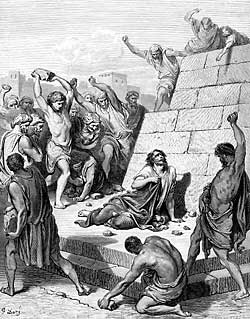
“But he, being full of the Holy Ghost, looked up stedfastly into heaven, and saw the glory of God, and Jesus STANDING on the right hand of God, And said, Behold, I see the heavens opened, and the Son of man STANDING on the right hand of God.” ~ Acts 7:55-56

As Stephen was being martyred, he looks up toward heaven and sees Christ, not sitting, but standing at the right hand of God. In one passage we see Christ sitting, and in another passage we see Christ standing. These scriptures are not in contradiction to one another. I believe that as Christ is sitting at God’s right hand he is looking down at us and watching us as a father would watch his children. When Christ sees one of his children doing something out of the ordinary (like willingly laying down his life for the sake of Christ) he stands up and begins to both cheer for him and to give him more grace.

When Stephen was being martyred for his faith in Christ, God began to use his death to create the momentum for a great Christian movement. In that crowd, witnessing the Spirit of God on this devoted martyr was a man named Saul who would eventually change his name to Paul, write nearly half of the New Testament, and start churches all over Europe and Asia.

Christ stood up, cheered for his devoted saint and decided to bless Stephen’s act of devotion beyond human measure! When this man, Obadiah Holmes, decided to suffer for Jesus, Christ must have looked down from heaven and decided to use him in much the same way as he used Stephen.

Here are some of the effects of the beating of Obadiah Holmes in Boston. John Spur, an on looker, gave testimony that being moved by the powerful faith of Holmes, he was born again during the beating of Obadiah Holmes! Amazing!

John Clarke, Holmes’ pastor, proficient in law, medicine, and theology, was moved by the beating of Holmes to write a book entitled, “Ill News From New England.” In this book, Clarke presented his philosophy of government and pushed for government not to interfere with man’s conscience relating to religious matters. These writing, in part, influenced the freedoms in America that were just around the corner.

On Feb. 10, 1702, Valentine Whiteman married Susanna Holmes, the grand-daughter of Obadiah Holmes and great-grand-daughter of Roger Williams who was called the apostle of freedom of conscience. In 1712, Whiteman moved to New York and started the first Baptist Church in New York City. Holmes had a godly offspring.

It is amazing how God used this man in early American history. Many of the early Baptist churches can trace themselves directly back to the influence of Obadiah Holmes and his godly posterity.

Whiteman won Wade Palmer who in turn won Schobel Stearns to Christ. Schobel Stearns probably deserves more credit than anyone else for the explosion of the gospel across the southern states. Schobel Stearns is credited by many as the father of the Bible belt. It is said that over 5,000 churches are direct descendants from Schobel Stearns.

That is a revival! Thousands of churches were started all across the south, transforming the entire political, social, and religious landscapes. Thousands and thousands were saved and baptized as a result.

I believe that Christ stood up that day as he looked down at Obadiah Holmes as he was stripped to the waist and beaten nearly to death. As that blood ran down and filled his shoes and pooled at his feet, I believe I can almost hear the savior shouting up in heaven, “I’m going to bless you, Obadiah! Don’t you give up! I’m going to bless you and your descendants beyond your wildest dreams! Obadiah, you won’t even know the extent that I’m going to bless you!”

I wonder if we would stand for the Lord Jesus Christ and just give our lives over to Him, how many lives we could influence for His glory! How many people would come into contact with us and their lives be so stirred because they saw somebody devoted and on fire for God!? How many of God’s blessings would he begin to pour over our lives and our nation for our sakes like he did for Obadiah?

Obadiah Holmes – An Unsung Baptist Hero

Labels: ,

Wednesday, November 29, 2006

The Beating of Obadiah Holmes - Tale of an Unsung Baptist Hero (Part 1)

Obadiah Holmes was born in Reddish, England in the year 1606. The king at this time was King James I, the man responsible for the translation of the King James Version of the Bible. Obadiah grew up working on his father’s farm in an England that mostly practiced Puritanism under the reign of King James I.

In his teen years, Obadiah watched England return to rigid Anglicanism as Charles I took the crown. Charles I made many changes to the political and religious landscape of England, and it was at this time that major religious persecution began to take place. In 1633, the Church of England began burning all Baptists, Puritans, and dissenters. They began beating and imprisoning people by the dozens. It is amazing that Puritans were burned alongside their Baptist persecuted brethren, and then they came to America and began to persecute them as well! These activities resulted in many people sailing to America in search of religious freedom. These were mostly puritans and a small group of Baptists.

Holmes was married to Catherine Hyde in 1630. He was saved in 1638 and set sail for New England that same year. After reaching the colonies, Holmes began to resist the false teaching of the standing order of the Puritan Church. He was plagued with many questions about their church: Was Baptism legitimate for infants? What if you were baptized and not a believer?

His faith in God and his knowledge of the Bible began to grow very much at this time, but it also began to cause some major problems and conflicts with the Puritans around him. Obadiah Holmes was willing to stand up against the standing Church.

Finally, without any prior training, Obadiah started a separate Congregational Church. This act shook up the standing order and Holmes was entirely ostracized. Later in 1649, John Clarke came to town. Under Clarke’s preaching, Holmes received assurance of his salvation, realized that he was a Baptist and was baptized by Clarke. Obadiah Holmes and John Clarke were now marked men by the standing order.

The persecution here in the United States, although many do not know this, was just as vehement and cruel as it was in England against those who did not conform to the religious guides of the standing order church. Our religious freedoms today have been heavily influenced by the persecuted Baptists of yester-year.

In 1651, the Newport Baptist Church received a request from a man eighty miles away named William Witter for a pastoral visit. Newport Baptist Church was the only Baptist church on American soil at this time. Obadiah Holmes was a member in good standing under the pastoral leadership of Pastor John Clarke. Witter was up in years and blind and was unable to attend church as he would like so he requested a pastoral visit from the only Baptist Church in America.

So upon request, John Clarke, Obadiah Holmes and one other layman set out to visit Witter. These three men set out to make an eighty mile pastoral visit. After several days of travel, they arrived at Witter’s home. They spent the night with Witter and planned to have church services with him on the following day, the Lord’s day.

As soon as news reached Lynn, Massachusetts, a warrant for their arrest was issued and a constable was dispatched to the home. They began their service the next day after four or five visitors arrived but were soon interrupted as the constables came bursting into the room. The constables arrested the three men and hauled them back to town.

They were forced that day to attend a puritan church in the afternoon. Again, it’s amazing that those who were persecuted in England are now the ones doing the persecution to the Baptists in the American colonies.

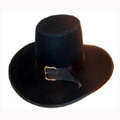
Upon entering the meeting house, the three tipped their hats but did not remove them. It being the custom to remove your hat in a church, this act suggested contempt for their services. They were saying that this was not a church. The preacher was not a preacher. Their infant baptism was no baptism. Their gospel was not the gospel of the Word of God. They kept their hats on.

The constable was commanded to knock off their hats and did so. Clarke attempted to preach during the middle of the service but was silenced. They were taken to prison.

On Tuesday, July 2, 1651, Holmes, Clarke, and Crandle (The third man) were taken to Boston. After an animated trial the judge agreed with the prosecutor, John Cotton, that these men were worthy of great punishment. Remember, these men were being tried for worshipping God in a private home right here on American soil.

Clarke was fined 20 pounds or be “well whipped”. Holmes was fined 30 pounds or be “well whipped”. Crandle was fined 5 pounds or be “well-whipped”.

Money was raised to pay the fines. Crandle was released from the fine. Clarke and Holmes refused permission for their fines to be paid, not willing to admit quilt, knowing that the whipping post was their alternative.

As Clarke was led to the whipping post, a friend pressed the money into the hands of the executioner and Clarke was released. It is unclear whether Clarke was in favor of this action, but from the record of his other actions, we can probably assume that he wasn’t. Either way, he was released.

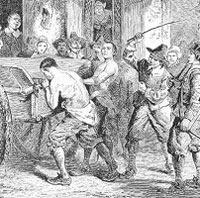
Holmes was led to the post and stripped to the waste. While being stripped and fastened to the whipping post, Holmes began to preach a sermon to the on looking crowd telling them to stay faithful to their beliefs. Holmes sentence was thirty lashes using a whip with three hard leather strands, the same as a rapist.

Many in the crowd cried out for mercy. At least thirteen people in the crowd were arrested for sympathizing with him. Each of the three strands tore skin away for a total of ninety gashes through the flesh. People screamed out in horror. History tells us that his blood ran down and filled his shoes.

The picture doesn’t do justice to the severe beating that this man endured because of his intense desire to love Christ supremely according to his conscience and the Word of God. Thank God for men who took a stand in years gone by so that we can enjoy the freedoms that we have today!

“For this is thankworthy, if a man for conscience toward God endure grief, suffering wrongfully. For what glory is it, if, when ye be buffeted for your faults, ye shall take it patiently? but if, when ye do well, and suffer for it, ye take it patiently, this is acceptable with God.” ~I Peter 2:19

Labels: ,